
Often, with the slightest tweak in understanding what the ego is,
problems turn into challenges, which then become adventures.
The Natural All-Rounder…
The idea of the ego can only really be understood by the all-rounder part of you because it is the all-rounder part of you which creates it.
This is good because if you are curious enough to follow through with such enquiries, then you will always be able to find a way back to your natural self, ready and refreshed to begin all-new adventures.
A Simple Way…
One of the most accessible ways to understand the concept of ego is to take the ‘eco’ angle.
The ego develops from our natural creative self in the same way that economic and money systems arise from our artistic pursuits. For this reason, the ego can be thought of as the ‘business end’ of the conscious mind, which is then reflected outwards in our everyday life.
How we run this ‘business’, this aspect of mind which we put to work, then determines our everyday expressions and experiences, individually and collectively.
In simple terms, if our top priority is to deliver up quality then quality will be delivered. If our top priority is to deliver up money then money will be delivered — however, the sting in the tail here is that beyond a certain point, a tipping point, this money will inevitably be delivered up at the expense of quality.
Suffice it to say that nature’s intent is to deliver up quality.
Live to Work, or Work to Live?
This well-known phrase immediately presents a problem as it already indicates that the individual and collective mind is being split apart, fragmented to an unhealthy degree.
Presenting in distorted form, this phrase originates from its most natural expressive state — which is live to play, or play to live — a core belief which works the same both ways around without creating any kind of separation.
In such a case, you could say just live, or play, or even work, and it would mean the same, achieving a balanced and beneficial flow of activity, a sweet spot in constant flux.
A Case In Point
If we look at the most recent wave of idea construction, the digital and computer age, it does not matter whether you ask if Microsoft’s Bill Gates, for example, was living, playing or working in what he chose to do, it all means the same as he did what he did because that is what he most enjoyed doing.
The amount of energy and knowledge Bill Gates and co-founder Paul Allen poured into and through the birth and growth of Microsoft fuelled the quality of its output for many years to come, with economic and money systems enabling this expansion.
Then, very gradually, comes a tipping point, where the original drive of natural creativity and quality has run its course, leaving a situation of measuring ‘money’ as the emerging yardstick of success.
At this point, the trajectory of mind starts to splinter away from the true ‘wave’ of the original artform, over-extending itself in an increasingly artificial way, gradually losing natural sustenance and quality in the process.
When this occurs, the mind, through its own free will, becomes too fragmented to fundamentally function in a ‘natural’ way, especially when the original co-creators find that they have increasingly less say in the running of the business which, by this time, continues on but with a wholly-changed primary directive to ‘deliver up money’.
Entanglement
This money directive becomes even more amplified when entities like Microsoft are ‘made public’, floated on the stockmarkets. The entity essentially then becomes answerable to the stockholders, such as investment companies and pension funds.
In different ways, such companies and funds are driven by the belief systems of each and every individual partaking, so entangling the mass population in a system of thought which places money before quality.
In simple terms then, current societal ‘norms’ lead to many individuals being influenced to invest in such belief systems in one way or another. And in so investing in them, reap all resulting outcomes over time, the very positive and the very not-so-positive.
From Boom-and-Bust to a Smooth Operator
When our everyday approach is overdone, when we overwork to the point of a split mind in any given moment of time (hour, day, month, year, century, millenia, etc), we can increasingly spoil our artistic expressions and experiences in life.
But when we find the right balance, the sweet spots, there is then no end to our creativity and the enhancing benefits that our ego can bring to our whole natural self.
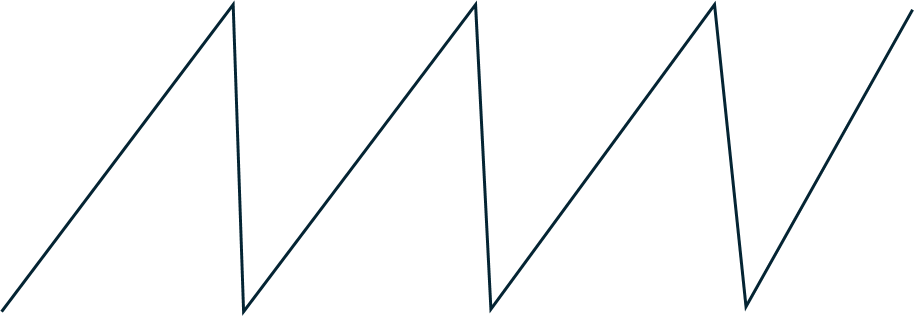
So what we are looking to do is turn this more volatile boom-and-bust pattern of egonomic activity …
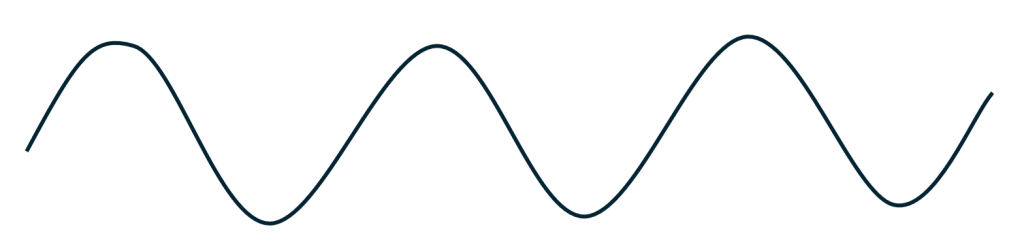
… into this more tuneful and timeful smooth-and-curved pattern of egonomic activity …
The boom-and-bust pattern is like a balloon being blown up beyond its individually designed stress limit, and then eventually making a big bang — bursting the balloon and creating a war-torn conclusion to all that good work done earlier in the process.
Whilst we might want to blame the ego in such an instance, it is more to do with poor teaching rather than the ego being a poor student.
From another angle, it is like saying ‘that car is a poor driver, it is a fact, I’ve seen it in my reality’, forgetting that the factual reality you experience is all to do with how it is driven, and so is again fundamentally to do with the teacher-student relationship that every conscious mind and ego is involved in.
If we never question the relatively uncomfortable ‘reality’ of boom-and-bust action, if we stop asking ‘why?’, then we will always experience boom-and-bust action, and this state of mind will also ‘colour’ our intrepretation of natural processes and principles, from the very large to the very small.
Expanding Beyond Less-Dimensional Frameworks by Thinking More-Dimensionally
In simple terms, we can start making progress by coming to understand that two-dimensional movement, up-and-down for example, is actually a less-dimensional version of a spinning round-and-round movement. Think for example of the two-dimensional waveform shown above as actually being a two-dimensional representation of a three-dimensional spiralling movement, like if you were to pick up a slinky, stretch it out, and view it sideways on.
The preference then, held as a core belief, for numbers or trajectories to always have to move upwards — as is the case with the money/productivity directive — is found to be incomplete, as it becomes clear that both [two dimensional] directions are welcome if true quality is to be found and maintained as a core directive.
One aspect is no longer seen to be superior to the other, as one cannot truly exist without the other — it is a pairing which generates natural equality across all dimensions. This ‘pairing’ exists first and foremost within your individual self, as you personally choose your own unique rhythms and phases of work and rest in accordance with your beliefs.
This more-dimensional approach puts the less-dimensional framework into better perspective, creating a bridge of understanding, so helping to positively change our way of thinking and acting, smoothing out the boom-and-bust cycles, transforming them into more energy-effective patterns of expression and experience, where metaphorically speaking we no longer have to keep reinventing the wheel.
So this approach of dimensional shifting works on the basis of changing your perception of ‘direction’ when focusing in a particular dimension, such as up-and-down in two dimensions, by looking at the same ‘movement’ in its next dimension, where up-and-down in three dimensional view is a round-and-round movement. This then removes any prejudiced perception of what any particular ‘direction’ means, simultaneously removing any artificial blockages that have accrued in your understanding of true ‘dimensionality’.
In removing these blockages, this has a double-boosting effect for the individual operator, whereby you no longer give energy to the frameworks generated from the earlier misunderstandings, instead now giving this same energy over to the incoming more-dimensional frameworks you are looking to work with. So the suppressive effect of the previous over-extended wave is removed, whilst simultaneously the now-unladen incoming wave gains an extra spring in its step.
A further benefit is that by removing your restricted view in any particular dimension, this then has a simultaneous effect across all dimensions — just as you have increased your understanding of two-dimensional movement by occupying a three-dimensional frame of mind in its interpretation, the experience of your usually perceived three-dimensional reality in everyday life starts to open up its fourth-dimensional potential (and beyond).
This situation in one sense has always been the case, it’s simply now that you are becoming more consciously aware of the production or construction of three-dimensional space and serial time as a perceived experience. This in essence is what is meant by an expansion of consciousness. You are expanding your perception of reality, a reality that always exists, but in which you now are becoming more skilled in being able to work with it by means other than just physical processing.
This gateway can only however be accessed by focusing on the theme of quality, which is nature’s intent. You are then both the gatekeeper and the invited guest.
The theme of money does not really come into this as a main player, other than realising that money exists in economic (and egonomic) markets of energy exchange because a gap exists between what is asked for and what is given, between question and answer, whereas there is little or no gap once you know, and therefore less need for any kind of medium, such as money (and time), to exist to bridge the gap.
This time reversion principle is discussed further in the manual, and at festival workshops.
Earth Analogy
Along with the conscious mind and ego, we are also aware that there are connected concepts which we generally name the unconcious and the subconscious. There is also the concept of the emotions.
To help understand these concepts in a different-to-usual way, we can use what I call the Earth Analogy. In doing so, this then helps to reveal that the mind is really no different to the body, it simply operates more-dimensionally across time, as well as space. In this sense, it can be said that the body is a counterpart of the mind, one reflecting the operation of the other.
UNCONSCIOUS ASPECT — the mind’s natural environment — the equivalent of planet earth’s wilderness in all its forms.
CONSCIOUS ASPECT — the mind’s expressor and experiencer — the human perceiver, creator and decision-maker — the natural all-rounder in human form.
SUBCONSCIOUS ASPECT — the mind’s built environment — aspects of mind ‘processed’ and ‘built’ from the unconscious aspect by the conscious aspect and its ego, and superimposed within the wilderness of the unconscious aspect.
EGO ASPECT — the mind’s specialist worker, ‘put to work’ by the conscious mind to process and build the subconscious aspect of mind. The ‘home’ of the ego is the conscious aspect of mind, or conscious mind for short.
EMOTIONS — the mind’s climate — the resulting ‘vibrancy’ of the emotions reflecting how well or otherwise we are designing, building and operating the subconscious aspect in time with the unconscious aspect. The emotions are then our primary indicator of quality approach.
QUALITY OF APPROACH — the conscious mind is primarily responsible for assessing its approach to life, not the ego. The ego is essentially the ‘business end’, reflecting the quality of approach taken by the conscious mind.
The Conscious Mind as a Subjective-Objective Hybrid Operator
Being the ‘business end’ of the conscious mind, the ego is essentially an ‘objective’ operator. In other words, as it is presently taught, it purely works on intellectual calculation, as most businesses do, with little room for feelings or emotions.
The conscious mind however, the home base, operates as you would do in a family situation, where money does not necessarily come into the equation, as it inherently knows nature works on the principle of swings and roundabouts. Translating this into how the mind works, the unconcious aspect is in constant communication and exchange with the conscious mind, freely offering up learning materials through which the conscious mind is able to develop and ideally enjoy ‘new’ knowledge as working models for the future, which in turn triggers biological responses and a natural flow or flux of evolution. Ask and it is given, as the saying goes.
This flow or flux of evolution observes interrelated time cycles of infinite degree across all dimensions, well beyond any kind of ‘objective’ calculation that can be made, so this is why it is important for the conscious mind to be the ‘person in charge’ of the ego, rather than the other way around.
If operating the other way around, where money and productivity unwittingly become the primary measures of success, the objective and intellectual ego — in many cases of quite ‘advanced’ capability — becomes a heavyweight influencer or dictator to the individual and collective conscious mind. Ironically, this happens because it loses proper connection with its own source of natural power, the unconscious aspect, and so gradually feels more and more powerless. This is why it will seek power over others, to try and fill this lack, albeit a temporary and ultimately doomed fix, as its objective timing within and amongst the natural time cycles mentioned above will continue to become dislocated and ultimately ‘break’ (as illustrated in the boom-and-bust drawing).
As a neutral tool or technology, there is however no need for the ego to have been taken down this path — in some ways representing an abdication by the conscious mind of its natural self-responsibilities early on in the proceedings. An ego that is developed properly can in fact operate in quite an opposite fashion — being an aid to the conscious mind rather than a tyrant, like a turbocharger on a car engine.
The hybrid nature of the conscious mind, being able to take into account feelings and emotions (subjective), as well as intellectual thought and logical rationalisation (objective), is of vital importance in this whole evolutionary process as its subjective components are able to intuitionally ‘feel’ the movement of ‘deep’ natural time well ahead of any intellectual calculation, which can become overly-complex and misleading.
These over-complications partly develop because objective time suffers a significant lag factor, especially when it enters its more advanced stages of development (ie electronic and nuclear capability). In simple terms, this lag factor can be easily appreciated and skilfully avoided once you know that any kind of objective moving average calculation is always behind time, late in its reporting — it is never truly representative of the ‘live game’, which is its source.
At such times, it is often better to take less notice of what might be called the influential momentum of the mass ego, and focus more on the operation of your individual ego and its more instantaneous feedback mechanisms.
In doing so, because your individual ego is now in the process of being gifted electronic and nuclear capabilities through its natural biological evolution, you will as an individual operator start noticing how your new creative ways of thinking and expressing yourself reflect in your everyday experiences, as you naturally begin again to create your own micro-climates and micro-landscapes of feelings and thought, which you then perceive materialising in your physical reality through your self-expansion of conscious awareness.