
Balance of Nonphysical Mind
Balance of mind is to do with TIME and timing.
As with our balance of body, achieving a balance of mind does not require any special, esoteric or extreme abilities or pursuits.
There is a very easy way to think about this, and this is to realise that just as how at a very young age we learn how to walk on our own two feet in SPACE, it is just as important to first learn how to walk through TIME.
As we then learn how to walk in both SPACE and TIME simultaneously, an automatic alignment to the ZERØ point is triggered, which becomes a door or portal to the next stage of development of expression and experience, whatever that may be for any particular individual.
What is currently happening in our world is that whilst we have grown the knowledge to move to the next stage, what is stopping us is that we are having trouble finding the door as our ‘trajectory’ is going off-course.
Thinking More-Dimensionally
Essentially, what we have to do is think ‘more-dimensionally’, echoing Doc Brown’s exclamations in the Back To The Future movies as Marty didn’t always latch on to thinking ‘fourth-dimensionally’.
In simple terms, we make progress by realising that up-and-down also means around-and around, and so by doing we can then tell in which direction we should be heading to find the doors which seem to so elude us.
Better still, by shifting our understanding in such a way, very little ‘energy’ is required thereafter, as the natural power of the ‘flux’ we are joining up with carries us along.
Mechanics of the Mind
The mechanics of the mind are not difficult to understand — we have already created many models which explain it — it’s simply that they exist as ‘fragments’ which need putting together to make a more explainable whole.
One of the most useful ways to understand the mechanics of the mind is to use analogies, to take what we already know about other things and see if they may apply in one way or another to those things we know less about, such as the mind.
When speaking of the mind, there are certain terms that most of us have heard being referred to, for example, such aspects of mind as the UNCONSCIOUS, the CONSCIOUS, and the SUBCONSCIOUS.
So taking these terms about our nonphysical mind, we can look around and see if there may be any corresponding aspects in our physical world that we can use as analogies to help further our understanding.
And a most useful one is what we can call the EARTH ANALOGY.
Earth Analogy
We can then look to make certain comparisons:
UNCONSCIOUS = The natural wilderness of Planet Earth — and beyond
CONSCIOUS = Human Beings, gifted with a natural creative ability to make ‘more’ from that which already exists
SUBCONSCIOUS = Parts of the Unconscious mind which have been creatively processed by the Conscious mind as it evolves
The beauty of the Earth Analogy is that we can immediately see that through our developing ideas and actions, we take from the Unconscious and build certain Subconscious landscapes and technologies of mind — our ‘built environment’ — which in turns affects the vibrancy of our mental climate and our Unconscious landscape — our ‘natural environment’.
We can also see that, even though we have an ability to create more from that which already exists, there is actually no overall change in quantity happening here. What is happening is a continually creative rearrangement of quantity to achieve something else — and that something else is… QUALITY.
Walking Through Time
Our human mind has an exceptional talent for generating ideas, original ideas, endlessly inspired internally by our imagination and externally by what we see around us.
And as we have an idea in our mental world, we can choose to bring it into the physical world for all to enjoy.
It takes ‘time’ to grow ideas, and theoretically we can say that each idea has an ideal pattern of growth which we can seek out, to yield optimum results.
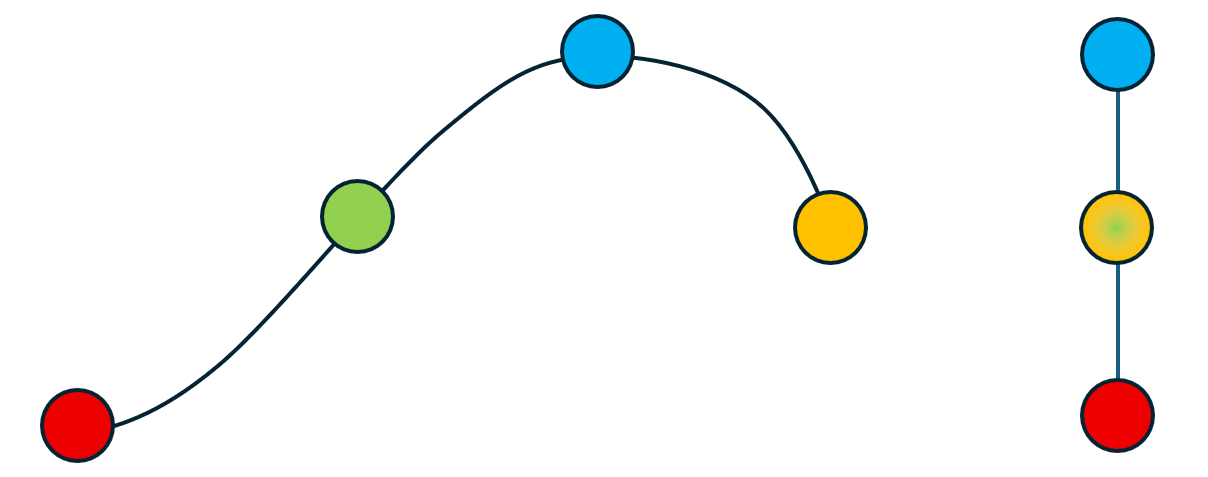
In the development of practically every idea, we can say that it has a ‘golden age’, a period when it reaches peak performance, though we can only really identify this in hindsight once we have moved well beyond this point and notice that further development is lacklustre in comparison. In other words, past a certain point, the quality of expression and experience drops away.
Using analogies to expand on this development principle, we can say for example that this ‘process’ is reflected in the children’s story of Goldilocks & The Three Bears, and can start to show some simple diagrams to highlight each stage:
To be continued…